 Poor little Downoi (Pogostemon helferi) is alive! I am saving it's life from the old tank, previously had grown up nearly to 20 plants, just a lack of good care cause everything has gone, just found the last small pity plant hiding in a dark corner. And now, it is alive, must take serious good care on it to grow more plants.

My Photography

Off topic post, recently a bit active in photo shooting more than aquascape. The reason why I do that is to understand the nature, like Mr Takashi Amano does. So is a helpful skill to develop our aquascaping and some nature behaviour. The place I am staying has such a limited stone scape, but worth for deep in study of the formation. If you like my photography, please drop a 'LIKE' on my link. Thank you very much.
Tuesday, April 20, 2010
Pity Downoi is Alive!
Poor little Downoi (Pogostemon helferi) is alive! I am saving it's life from the old tank, previously had grown up nearly to 20 plants, just a lack of good care cause everything has gone, just found the last small pity plant hiding in a dark corner. And now, it is alive, must take serious good care on it to grow more plants.

Sunday, April 18, 2010
Just added Ember Tetra (Hyphessobrycon amandae)
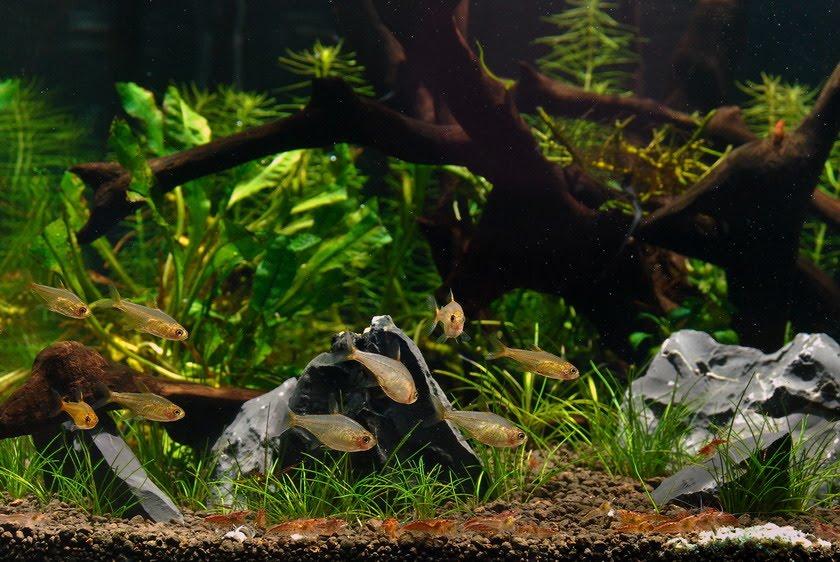 Last 2 days visited to a local fish shop(LFS) and bought these small size fish, in fact never saw Ember Tetra before, totally no idea the fish characteristic, but that 2cm maximum length attracted me. I was thinking to have some small fish in the tank, but normally found the 4~5cm in size, it is a bit too big for me, these 2cm Ember Tetra really rare and hard to find in any LFS.
Saw some others has the redish color fish, but what I have is the orange color species, I am still thinking the color has a bit wash out, need to adjust the water condition to see any changes. Here are some info found from the internet.
Family : Characidae
Distribution : Rio Araguaia basin, Brazil.
Habitat : Inhabits quiet tributaries off the main river channels, backwaters and oxbow lakes. It often gathers under cover of overhanging or marginal vegetation.
Maximum Standard Length : 0.8" (2cm)
Minimum Tank Size : A standard 18" x 12" x 12" (45cm x 30cm x 30cm) - 42 litre tank is easily big enough for a shoal of these.
Tank Setup : A biotope setup would be very simple to arrange. Use a substrate of river sand and add a few driftwood branches (if you can't find driftwood of the desired shape, common beech is safe to use if thoroughly dried and stripped of bark) and twisted roots. A few handfuls of dried leaves (again beech can be used, or oak leaves are also suitable) would complete the natural feel. Aquatic plants are not a feature of this species' natural waters. Allow the wood and leaves to stain the water the colour of weak tea, removing old leaves and replacing them every few weeks so they don't rot and foul the water. A small net bag filled with aquarium-safe peat can be added to the filter to aid in the simulation of black water conditions. Use fairly dim lighting.
Alternatively, it also does well in a well maintained, heavily planted tank. As any of these seen for sale will almost certainly be wild caught a more general setup is not really suitable.
Temperature : 75-82°F (24-28°C)
pH Range : 5.5-7.0. It tends to appear a little pale and washed out when kept in alkaline conditions.
Hardness : 1-10°H
Diet : Omnivorous and will accept just about anything offered. It does have a small mouth, though, so correspondingly-sized foods are best. Feed a mixture of dried flakes and granules and small live and frozen foods. A varied diet, such as this, is essential for the best colour development.
Compatibility : It's a very peaceful species that won't compete well with very boisterous or much larger tankmates. The tiny adult size means it also makes a tasty snack for many commonly kept species, such as angelfish or some gouramis. Ideally, keep it with other quiet South Americans, such as small tetras, pencil fish, Apistogrammadwarf cichlids, dwarf Corydoras and Otocinclus. It could also be combined with smaller cyprinids and Anabantoids if geography isn't an issue.
Always buy a group of at least 6 of these, preferably 10 or more. It is a shoaling species by nature, and will fare much better when in the company of its own kind. Like most tetras it actually looks far more effective when maintained like this anyway.
Sexual Dimorphism : Females are stockier than males, particularly when in spawning condition.
Breeding : Can be bred in a similar way to other species in the genus. You'll need to set up a separate tank if you want to raise decent numbers of fry. Something around 18" x 10" x 10" in size is fine, and you could even get away with something a little smaller. This should be very dimly lit and contain clumps of fine-leaved plants such as java moss or spawning mops, to give the fish somewhere to deposit their eggs. Alternatively, you could cover the base of the tank with some kind of mesh. This should be of a large enough grade so that the eggs can fall through it, but small enough so that the adults cannot reach them. The water should be soft and acidic in the range pH 5.5-6.5, gH 1-5, with a temperature of around 80-84°F. Filtering the water through peat is useful, as is the use of RO water. A small air-powered sponge filter bubbling away very gently is all that is needed in terms of filtration.
It can be spawned in a group, with half a dozen specimens of each sex being a good number. Condition these with plenty of small live foods and spawning should not present too many problems.
Alternatively, it can be spawned in pairs. Under this technique, the fish are conditioned in male and female groups in separate tanks. When the females are noticeably full of eggs and the males are displaying their best colours, select the fattest female and best-coloured male and transfer them to the spawning tank in the evening. They should spawn the following morning.
In either situation, the adults will eat the eggs given the chance and should be removed as soon as eggs are noticed. These will hatch in 24-36 hours, with the fry becoming free swimming 3-4 days later. They should be fed on an infusoria-type food for the first few days, until they are large enough to accept microworm or brine shrimp nauplii.
Wednesday, April 14, 2010
DIY a L-pole to suspend the light
It is a pretty fast & simple materials to DIY a light pole/bracket for your aquarium light to a suspend type, first of all need to buy some materials from hardware shop:
1.) L1800mm~2100mm shower curtain rod - RM15.90 (approx US$4.95)
2.) L900mm~1200mm shower curtain rod - RM12.90 (approx. US$4.00)
3.) Curtain wire from IKEA - RM19 (approx. US$5.90)
4.) U shape plastic clip & holder 2 sets - RM2.00 (approx. US$0.65)
5.) Metal wire robe clamp 2 nos. - RM1.80 (approx. US$0.55)
6.) PVC T join for plumbing - RM1.50 (approx. US$0.45)
In total spent of RM52.05(US$16.50) to DIY it. How to make it? From the photos below tell more than words.

join 2 metal rod with this PVC T join. (My cousin complained it does a bit ugly look, but no other parts can replace it at the moment.)

U shape plastic clip & holder to firm the bottom part of metal rod.

U shape plastic clip & holder to firm the middle part of metal rod.

Curtain wire set included this metal wall fitting from IKEA, screwed it on the aluminium light case.

Wire robe clamp to tighten the metal wire.

Here is the final product, it isn't ugly look with all these materials easily found in any hardware shop.
Tuesday, April 13, 2010
Upgraded CO2 diffuser
The old CO2 diffuser really looks huge inside the tank, just upgraded to an external type + DIY bubble counter(will upgrade that soon).

So far the rubber seal at the bottom cover of new CO2 diffuser no water leakage and the mixing process is great with some fine bubble produces.

Overall, quite like the new CO2 diffuser, my tank is clean look without the old huge CO2 diffuser. Since the ugly diffuser gone, now the digital thermometer is an issue to me, looks big in front. Another item need to take away soon.
Monday, April 12, 2010
ADA International Aquatic Plants Layout Contest (IAPLC) 2009 winners' photo
Recently busy about my job, that's why nothing to post for weeks, and also the new tank had some algae growth. Luckily I bought the Seachem Excel to control the algae from growing fast. Planned to do some rescape later when I am free.
For this year 2010 IAPLC, I am not able to join due to the time frame is too near, and my tank still need times to grow the plants & some fine tuning or trimming. But anyway, next year will participate in the contest.
Here are some collection photos of ADA International Aquatic Plants Layout Contest (IAPLC) 2009 winners' ranking from #1~27 that can be found in Saigon Aqua. They are great, they are deserve for the top 27.

1 Nguyen Tien Dung, VIETNAM
Title: Moment In Time
Title: Moment In Time

2 Chan Shih Hsien, TAIWAN
Title: Magic Forest

3 Yuji Yoshinaga, JAPAN
Title: Time of Eternity (Yaku Island)

4 Josh Sim KH, MALAYSIA
Title: Awakening

5 Wang Chao, CHINA
Title: Looking for Mystery

5 Chow Wai Sun, HONG KONG
Title: Towering Peaks

7 News Chuan Lin, TAIWAN
Title: Forest-Breath

8 Nguyenthi Xuanthuy, VIETNAM
Title: Ups and Downs

9 Ngo Truong Thinh, VIETNAM
Title: Peaceful

10 AJ Judy Prajitno Putra, INDONESIA
Title: Fearless: Spirit of the Rainforest

11 Hsu Yung Lin, TAIWAN
Title: Rain Forest

12 Yee Kin Cheong, MALAYSIA
Title: Forest Path

13 Cliff Hui, HONG KONG
Title: Treasure

14 Wong Kam, HONG KONG
Title: The Phoenix and The Dragon

15 Tatsuo Harada, JAPAN
Title: Over the Blue

16 Zentaro Watanabe, JAPAN
Title: A Silent Morning
Title: A Silent Morning

17 Eishi Yamamoto, JAPAN
Title: A Breezeway in the Valley

18 Zhang Jianfeng, MACAU
Title: Roar of Yellow River

19 Yeo Siak Wee, MALAYSIA
Title: Mystique River
20 Hidekazu Tsukiji, JAPAN
Title: Wind from the South

21 Hironori Handa, JAPAN
Title: Cloud

22 Pasquale Buonpane, ITALY
Title: Oriens et Occasus (East and West)

23 Szymon Fiedorowicz, POLAND
Title: Swampland

24 Nguyen Ngoc Tri Nhan, VIET NAM
Title: Whispers of Stones

25 Artur Frankowski, POLAND
Title: The Lost Canyon

26 Jullawong Papunta, THAILAND
Title: Rainny Season on My Home

27 Jamie Lin, TAIWAN
Title: Mysterious Bermuda
Subscribe to:
Posts (Atom)